
“To eat is a necessity, but to eat intelligently is an art.” — François de La Rochefoucauld
On January 7, the 2025–2030 Dietary Guidelines for Americans (DGAs) were released, and suddenly my feed was filled with hot takes, headlines, and conflicting interpretations.
Rather than add to the noise, I wanted to take time to read and analyze the current DGAs compared to previous versions. I thought it would be more helpful to share a grounded breakdown of what these guidelines actually say and offer some professional context on how I view them.
As someone who teaches Contemporary Diet & Nutrition at Purdue Global University — which includes an entire unit on the DGAs — I’ve spent significant time reviewing both the science and policy behind these recommendations. Let me start by say the DGAs have never been perfect and they never will be. The goal should always be to evolve with science and keep an open-mind, what works for one will never work for all. This DGA is no exception, it has real positives and real negatives. Let’s dive in!
Noticeable Changes
“Real Food” First
The new guidance places a stronger emphasis on whole, nutrient-dense foods — including protein foods, dairy, vegetables, fruits, healthy fats, and fiber-rich whole grains.
Protein Prioritized at Every Meal
Unlike prior guidelines, where protein was part of a balanced pattern, the new edition explicitly recommends prioritizing high-quality protein at every meal.
Suggested intake is now 1.2–1.6 grams of protein per kilogram of body weight per day, compared to the long-standing 0.8 g/kg/day RDA minimum (but don’t get confused, this still is the RDA).
Focus on Healthy Dietary Fats
Full-fat dairy products (without added sugars) are now endorsed, reversing decades of advice favoring low-fat or fat-free dairy.
While dairy can be a nutritious option for some, it’s worth noting that approximately 65–75% of the global population has some degree of lactose intolerance. I have never believed dairy needs to be a required component of dietary guidance, though it may be appropriate for individuals who tolerate it well, so this edition is no different.
Saturated fats from whole-food sources are acknowledged as acceptable so long as overall intake remains under 10% of daily calories. This percentage cap remains unchanged from previous editions. However, the higher placement of red meat, butter, and full-fat dairy — all significant sources of saturated fat — has created some confusion.
The guidelines reference essential fatty acids (EFAs) and cite olive oil as an example. Olive oil is primarily composed of monounsaturated fat (oleic acid), which is beneficial for heart health but is not technically an essential fatty acid because the body can synthesize it. True essential fatty acids include linoleic acid (omega-6) and alpha-linolenic acid (omega-3), found in foods such as hemp seeds, chia seeds, flaxseeds, and walnuts. These small factual inaccuracies, especially in this shorter report, can raise questions about thoroughness and editorial precision.
Carbohydrates — More Whole Grains, Less Highly Processed Foods and Sugar
The guidelines explicitly discourage highly processed foods, including sugar-sweetened beverages, packaged salty or sweet snacks, and ready-to-eat convenience foods.
Added sugars and non-nutritive sweeteners are discouraged, with the statement that no amount is considered part of a healthy dietary pattern. The recommendation suggests limiting added sugar to approximately 10 grams per meal — which could be significantly less than the previous 10% of total daily calories (up to 50 grams per day in a 2,000-calorie diet).
The guidance emphasizes choosing fiber-rich whole grains over refined grains, with suggested intake ranging from 2–4 servings daily.
Alcohol Guidance Changed
Previous DGAs gave specific drink limits (1 drink per day for women, 2 for men). The new version shifts to broader language, encouraging people to “consume less alcohol for better health” and recommending avoidance for certain populations (e.g., pregnant individuals, those with alcohol use disorder).
Gut Health, Digestion & Fermented foods
For the first time ever the DGAs mention how important gut health is (one of my main specialties, go ahead call me an influencer if you want, because apparently that’s what this says, but I always cite evidence and have seen first hand how much addressing the gut helps majority of my private clients) and call out the “microbiome” and fermented foods and how vital they are for good digestion.
Questionable Hierarchy in the Reverse Pyramid
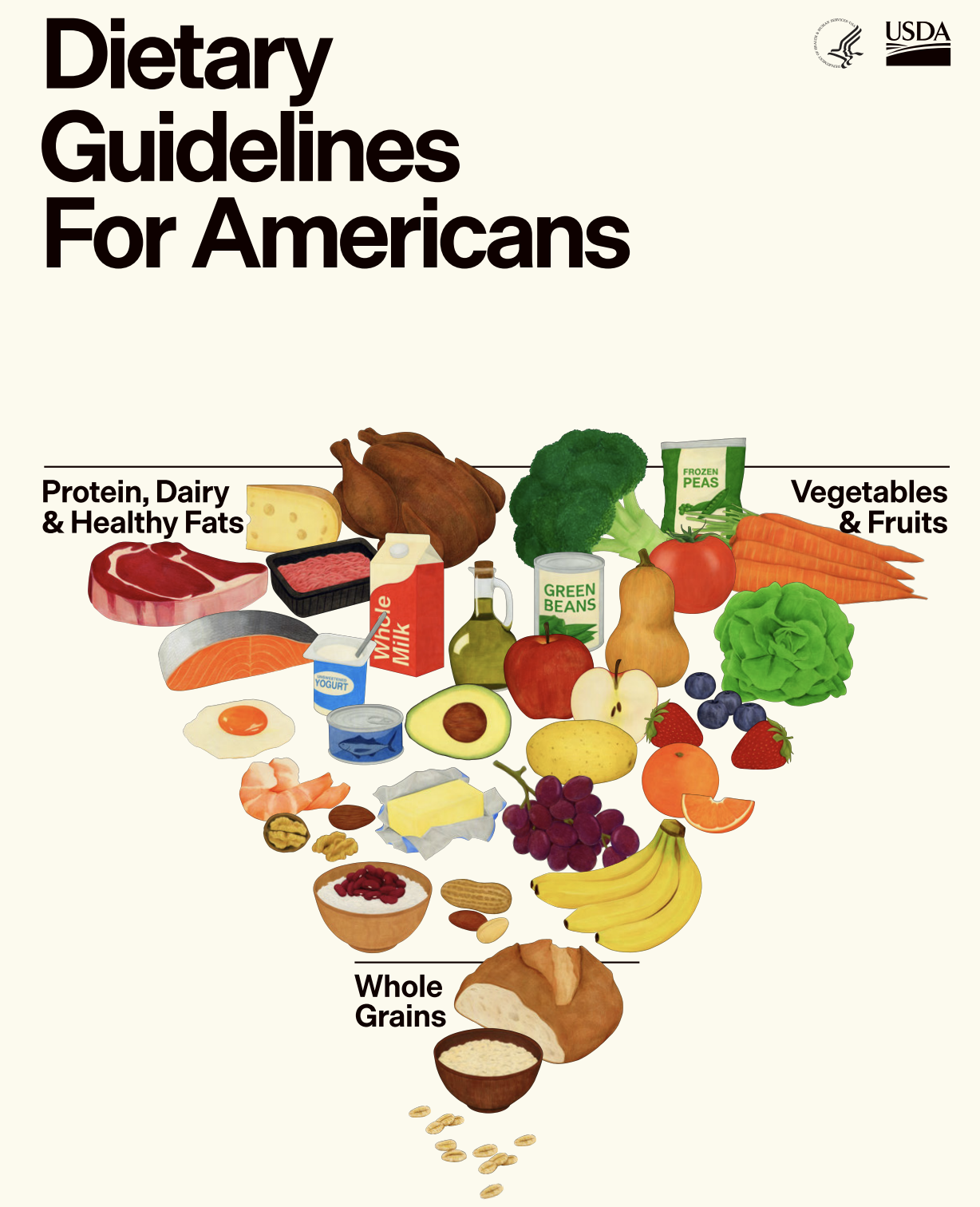
The visual “reverse pyramid” places red meat, butter, and full-fat dairy near the top, which raises questions given the continued 10% saturated fat limit. Whole grains appear at the bottom despite the 2–4 serving recommendation. The visual hierarchy may create mixed messaging.
Removal of Environmental and Cultural Language
Previous editions included discussion of sustainability and cultural considerations. Food production has major environmental consequences, and food choices are influenced by income, access, culture, and geography. Without these considerations, recommendations may not feel practical or equitable for all populations.
Concerns About Transparency
Historically, we have a list of names, scientists and more than wrote the DGAs. As of now, we have none of that. Additionally, it’s been called out by some that there are people of interest in the HHS or the DGA committee that have financial ties to the beef and dairy industry, which raises questions about their placement on this pyramid graphic.
Overall this chart from Marion Nestle “Food Politics” is a great chart to see clearly how things have changed in real numbers.
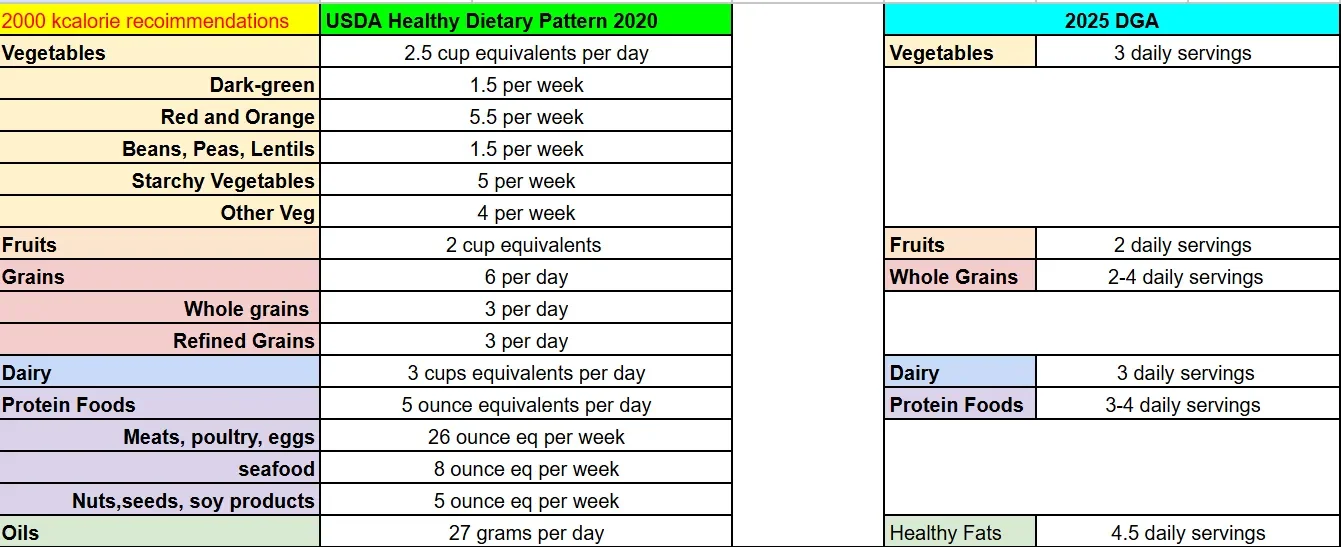
Image via Marion Nestle and Food Politics
Why This Matters
While many argue that most Americans do not closely follow the DGAs, they do still shape federal programs such as SNAP, school meal standards, military dining, and broader food policy, and more. They also influence:
Health professionals and nutrition educators
Federal nutrition programs
Policymakers
Food industry strategy and product development
Media narratives around nutrition
A great historical example can be seen from the 80s and 90s days of non-fat/low fat and the takeover of sugar. Research that was funded by these industries strongly shape our DGAs for decades.
Key Takeaways
✔ Eat more whole, real food
✔ Prioritize high-quality protein at each meal
✔ Full-fat dairy is considered acceptable
✔ Strongly avoid/limit ultra-processed foods, refined grains and added sugars
✔ Alcohol guidance emphasizes that less is better, none is preferred
✔ Core goals — reducing chronic disease risk and meeting nutrient needs — remain unchanged
My Professional Perspective
Overall, I view this as a modest step in a generally positive direction, particularly regarding reduced alcohol messaging, more protein, less processed, refined and added sugars and emphasis on whole real foods.
But there are real glaring issues. The 2020-2025 DGAs were 164 pages reduced to 10 for this 10th edition of the DGAs, very vague, generalities with very little to no transparency over who wrote them, who was paid by lobbyists (some call this the Rancher’s Pyramid, believing many were paid by the beef and dairy industries). Questions around food hierarchy remain — for example, whether certain foods are being visually elevated beyond what the evidence clearly supports.
I have never believed dairy should be included for all, given widespread lactose intolerance and the availability of alternative nutrient sources, especially for calcium.
And the removal of environmental, cultural and socioeconomic context is notable. Nutrition policy does not exist in isolation from food systems.
Finally, even minor factual inconsistencies can weaken confidence in a document intended to guide national health policy.
Finally, I would be remise as a Coloradan, if I didn’t mention the upside down pyramid that South Park created back in 2014! Check it out, it’s pretty wild!
As I stated above, the DGAs will never be perfect. Personalized nutrition is ultimately the gold standard, and it is impossible to create one-size-fits-all guidance for an entire population.
Your body, health history, genetics, preferences, and goals will always matter more than generalized recommendations.
If you’re feeling more confused than ever — or would like personalized guidance — consider working with a Registered Dietitian (RD) or Certified Nutrition Specialist (CNS), like myself. You’re also welcome to book a free 15-minute strategy session with me to explore what’s going on and whether we’d be a good fit.
Now go eat your vegetables! 😉