

If you’ve ever searched for a nutrition professional, you’ve probably seen a swirl of letters after people’s names — CNS, RD, LDN — and wondered, what do they all mean?
While all three designations represent advanced training in nutrition, the pathways, philosophies, and scopes of practice can differ quite a bit. Here’s a breakdown to help you understand who’s who in the world of nutrition.
What Is a CNS (Certified Nutrition Specialist)?
A Certified Nutrition Specialist (CNS) is a clinically trained nutrition professional with advanced education in biochemistry, functional nutrition, and integrative health.
To earn the CNS credential, individuals must:
Hold a master’s or doctoral degree in nutrition or a related clinical field
Complete 1,000 supervised clinical hours
Pass a rigorous board exam through the American Nutrition Association (ANA)
Maintain continuing education to stay current in nutrition science and clinical practice
CNS professionals often take a functional and root-cause approach—looking beyond symptoms to understand how diet, lifestyle, genetics, and metabolism interact. Many CNSs work in private practice, integrative clinics, or functional medicine settings, using advanced testing and personalized nutrition protocols.
✅ Best for: Individuals seeking a holistic, science-based, and personalized nutrition approach
🏥 Common workplaces: Functional medicine clinics, private practice, integrative health centers
🍎 What Is an RD (Registered Dietitian)?
A Registered Dietitian (RD)—also referred to as Registered Dietitian Nutritionist (RDN)—is a nutrition professional credentialed through the Commission on Dietetic Registration (CDR), a part of the Academy of Nutrition and Dietetics.
To become an RD, individuals must:
Earn at least a bachelor’s degree, and now as of 2024, a master’s degree is required
Complete an ACEND-accredited dietetic internship ~about 1,200 supervised practice hours
Pass a national board exam through CDR
Meet ongoing continuing education requirements
RDs are trained in medical nutrition therapy (MNT) and are qualified to work in hospitals, long-term care, public health, and corporate wellness settings. Their training emphasizes evidence-based nutrition within the traditional healthcare system.
✅ Best for: Individuals seeking conventional medical nutrition therapy or working within healthcare systems
🏥 Common workplaces: Hospitals, outpatient clinics, public health departments, corporate wellness programs
⚖️ What Is an LDN (Licensed Dietitian Nutritionist)?
The LDN (Licensed Dietitian Nutritionist) is a state-level license, not a national credential.
It allows qualified nutrition professionals — both RDs or CNSs, depending on the state — to legally practice personalized and medical nutrition therapy, and accept insurance if they choose.
Each state has its own laws regulating nutrition practice:
In a few states (around 6 states as of 2024) only RDs can hold an LDN license
In others (like Maryland or Illinois), CNSs and RDs can both become LDNs
Some states have title protection laws, meaning you must hold an LDN to use titles like “nutritionist” or “dietitian.”
✅ Best for: Practitioners who meet education and supervision standards and want to legally provide individualized nutrition care or accept insurance
⚖️ Regulated by: Each state’s Board of Dietetics and Nutrition
🥦 Key Differences at a Glance
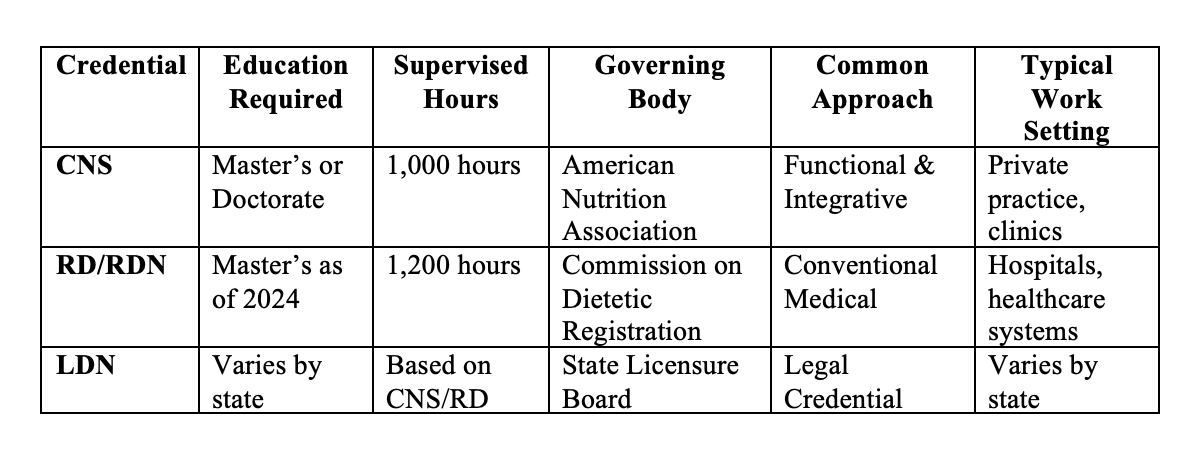
🧩 Choosing the Right Path
Whether you are thinking of hiring a dietitian or nutritionist or you’re thinking about a career in nutrition, the right credential depends on your goals and philosophy:
If you love functional medicine, root-cause approaches, and personalized care, the CNS route may be your fit.
If you want to work in hospitals, long-term care, or public health, the RD route is ideal.
If you already have a credential and want to practice legally, you’ll need to check your state’s LDN requirements.
No matter the path, all three credentials share a common goal: helping people use food as powerful, science-backed medicine.
🥦 What Is a Nutritionist — and Who Can Call Themselves One?
The term “nutritionist” is broad and not consistently regulated across the United States. In some states, anyone can call themselves a nutritionist regardless of education or training, while in others, the title is protected by law and reserved for those who hold specific credentials such as a Certified Nutrition Specialist (CNS) or Registered Dietitian (RD). Because of this variation, the expertise of someone using the title “nutritionist” can range from a highly trained clinical professional to someone with minimal formal education in nutrition.
Each state sets its own rules for who can legally provide nutrition counseling or use titles like “licensed nutritionist” or “dietitian.” For example, states such as Florida and Maryland require licensure for both RDs and CNSs, while others, including Colorado, do not regulate the term “nutritionist” at all. This means clients should always check a practitioner’s credentials — looking for degrees, certifications, and supervised experience — to ensure they’re working with a qualified professional.
🌿 Final Thoughts
The nutrition field is evolving fast. Today’s clients are looking for nuanced, whole-body approaches, and both CNSs and RDs play vital roles in improving public health.
Whether you’re a client seeking the right professional or a student exploring your future path, understanding these distinctions helps you make an empowered choice.
If you’re finishing your master’s and working toward your CNS credential, the CNS Alliance is the perfect next step. You’ll get support with amazing supervisors, completing your 1,000 supervised hours, and preparing for the board exam—plus a community of nutrition professionals who’ve been right where you are.
Disclaimers
The information provided on this website and blog is not affiliated with or endorsed by the American Nutrition Association®, the Board for Certification of Nutrition Specialists℠, or the Certified Nutrition Specialist® (CNS®) credential.
For official information about these organizations, please visit theana.org and theana.org/certify.
This website and blog are also not affiliated with or endorsed by the Academy of Nutrition and Dietetics or the Commission on Dietetic Registration.
For official information about these organizations, please visit cdrnet.org and eatright.org.